Newsletter
4 newsletters to display
M3 Job Club creates a newsletter periodically to keep our friends, supporters and followers up-to-date with the activities and events of the profile. It is delivered via our friends email mailing list.
Anyone can subscribe to this mailing list to receive our newsletters as they are released.
To subscribe (or unsubscribe), enter your email address in the box to the right...
Below is a list of all past issues...
Member Survey Reveals Powerful Impact of M3 Job Club on Confidence, Skills and Employment Outcomes
Sat, 31 Jan 2026Printable version
The latest member survey offers one of the clearest pictures yet of the difference the M3 Job Club makes in people’s lives. Across 60+ respondents, the M3 Job Club demonstrates a clear and measurable impact on mid‑career and late‑career professionals navigating unemployment, redundancy, and career transition. Members consistently describe the club as a lifeline, providing structure, practical skills, confidence, and a supportive community at a time when the job market feels more complex and competitive than ever.
Who We Support
M3 Job Club serves mid‑career and senior professionals who are unemployed, at risk, or navigating career transition, providing the practical skills, structure, and community support they need to regain confidence and return to meaningful work. A recent survey shows the predominant age range of members responding are aged 46–65, who make up over 70% of all respondents. This is the demographic most affected by redundancy, age bias, and the rapid evolution of recruitment practices.
Attendance & Engagement
Among those seeking work, over 85% are actively attending weekly sessions.
Among those in employment, fewer than 10% continue to attend, typically to give back or maintain networks.
This shows:
High engagement where support is needed most
Across all respondents who have left the club:
Impacts
The qualitative comments reveal strong, consistent themes, in order of prevalence:
A. Emotional & Mental Health Support
This is the single strongest theme.
Members describe the club as:
B. Practical Skills & Session Value
Members repeatedly cite specific sessions as transformational:
C. Community & Peer Support
Members emphasise:
D. Networking & Employer Access
Members highlight:
Career Change & Self‑Employment
Several members moved into self‑employment, often citing the club as the catalyst.
The M3 Job Club delivers measurable, life‑changing impact for mid‑career and late‑career professionals, those most at risk of long‑term unemployment and least served by mainstream provision. Over 70% of respondents fall within the 46–65 age range, a demographic disproportionately affected by redundancy and age bias. Among those seeking work, over 85% actively attend weekly sessions, demonstrating strong engagement and trust in the programme.
The club’s practical interventions, such as CV writing, interview preparation, AI/ATS training, and job search strategy, are cited by 70% of respondents as directly improving their employability.
More than half of all employed respondents attribute their successful job outcome to the club’s support. Emotional and mental health benefits are equally significant: 60% describe the club as essential in reducing isolation, rebuilding confidence, and maintaining resilience during a challenging job search.
The M3 Job Club provides a unique combination of professional‑level employability training, peer support, and community connection. It is a proven, high‑impact, free‑at‑point‑of‑use service that fills a critical gap left by statutory provision, particularly for experienced professionals navigating a rapidly changing job market.
Who We Support
M3 Job Club serves mid‑career and senior professionals who are unemployed, at risk, or navigating career transition, providing the practical skills, structure, and community support they need to regain confidence and return to meaningful work. A recent survey shows the predominant age range of members responding are aged 46–65, who make up over 70% of all respondents. This is the demographic most affected by redundancy, age bias, and the rapid evolution of recruitment practices.
- 51–60 age group: ~45% of all respondents
- 61–65 age group: ~20%
- 46–50 age group: ~15%
Attendance & Engagement
Among those seeking work, over 85% are actively attending weekly sessions.
Among those in employment, fewer than 10% continue to attend, typically to give back or maintain networks.
This shows:
High engagement where support is needed most
- A natural “graduation” pattern once employment is secured
- A strong alumni culture
Across all respondents who have left the club:
- Full‑time employment: ~55%
- Part‑time employment: ~10%
- Self‑employment: ~5%
- Still seeking work: ~30%
Impacts
The qualitative comments reveal strong, consistent themes, in order of prevalence:
A. Emotional & Mental Health Support
This is the single strongest theme.
Members describe the club as:
- “a life saver”
- “a tonic”
- “stopped me feeling isolated”
- “helped me through dark times”
B. Practical Skills & Session Value
Members repeatedly cite specific sessions as transformational:
- CV writing (most frequently mentioned)
- Interview preparation
- AI/ATS navigation
- Job search strategy
- Networking skills
- Professional photography
- Buddy programmes
C. Community & Peer Support
Members emphasise:
- belonging
- shared experience
- empathy
- non‑judgemental culture
- encouragement
D. Networking & Employer Access
Members highlight:
- meeting employers
- alumni support
- referrals
- external speakers
Career Change & Self‑Employment
Several members moved into self‑employment, often citing the club as the catalyst.
The M3 Job Club delivers measurable, life‑changing impact for mid‑career and late‑career professionals, those most at risk of long‑term unemployment and least served by mainstream provision. Over 70% of respondents fall within the 46–65 age range, a demographic disproportionately affected by redundancy and age bias. Among those seeking work, over 85% actively attend weekly sessions, demonstrating strong engagement and trust in the programme.
The club’s practical interventions, such as CV writing, interview preparation, AI/ATS training, and job search strategy, are cited by 70% of respondents as directly improving their employability.
More than half of all employed respondents attribute their successful job outcome to the club’s support. Emotional and mental health benefits are equally significant: 60% describe the club as essential in reducing isolation, rebuilding confidence, and maintaining resilience during a challenging job search.
The M3 Job Club provides a unique combination of professional‑level employability training, peer support, and community connection. It is a proven, high‑impact, free‑at‑point‑of‑use service that fills a critical gap left by statutory provision, particularly for experienced professionals navigating a rapidly changing job market.

This New Year, Choose Hope Over Resolutions
Wed, 31 Dec 2025Printable version
Every January, we’re handed the same script:
Set goals. Fix yourself. Become a better version of you.
And every January, thousands of people step into the New Year already carrying enough weight - redundancy, uncertainty, a job market that feels unrecognisable, confidence that’s been chipped away one rejection at a time.
The last thing they need is another stick to beat themselves with.
Over the past few days, between Christmas and New Year, I’ve been reading through the recent M3 Job Club member survey. Page after page, one message came through louder than anything else:
People don’t need resolutions.
People need hope.
People need each other.
Not one person said, “I succeeded because I made a New Year’s resolution.”
But they did say:
“It picked up the shattered pieces of my life.”
“It reminded me I’m not a failure.”
“It stopped me feeling alone.”
“It gave me structure, purpose, and confidence.”
“It made my future look brighter.”
These aren’t comments about productivity.
They’re comments about humanity.
Support. Hope. Empowerment. Community. Belonging.
That’s what changes lives.
Not a list of resolutions taped to the fridge.
When someone walks into the club for the first time, they’re not looking for a motivational slogan. They’re looking for a place where they don’t have to pretend. A place where they can breathe. A place where they can say, “I’m struggling,” and hear, “You’re not alone.”
And that - more than any January promise - is what helps people rebuild.
So here’s our New Year message:
If you’re out of work, in transition, or simply exhausted by the pressure to reinvent yourself every January:
You don’t need a new you.
You need support, connection, and hope.
You need people who see your value even when you can’t.
And if you’re someone who can offer that, as an employer, policymaker, community leader, or simply a human being, then this is your moment.
As we step into 2026, let’s stop asking people to “do better”.
Hope is structural.
Hope is strategy.
Hope is what gets people back on their feet.
And right now, hope is exactly what the world needs more of.
Set goals. Fix yourself. Become a better version of you.
And every January, thousands of people step into the New Year already carrying enough weight - redundancy, uncertainty, a job market that feels unrecognisable, confidence that’s been chipped away one rejection at a time.
The last thing they need is another stick to beat themselves with.
Over the past few days, between Christmas and New Year, I’ve been reading through the recent M3 Job Club member survey. Page after page, one message came through louder than anything else:
People don’t need resolutions.
People need hope.
People need each other.
Not one person said, “I succeeded because I made a New Year’s resolution.”
But they did say:
“It picked up the shattered pieces of my life.”
“It reminded me I’m not a failure.”
“It stopped me feeling alone.”
“It gave me structure, purpose, and confidence.”
“It made my future look brighter.”
These aren’t comments about productivity.
They’re comments about humanity.
Support. Hope. Empowerment. Community. Belonging.
That’s what changes lives.
Not a list of resolutions taped to the fridge.
When someone walks into the club for the first time, they’re not looking for a motivational slogan. They’re looking for a place where they don’t have to pretend. A place where they can breathe. A place where they can say, “I’m struggling,” and hear, “You’re not alone.”
And that - more than any January promise - is what helps people rebuild.
So here’s our New Year message:
If you’re out of work, in transition, or simply exhausted by the pressure to reinvent yourself every January:
You don’t need a new you.
You need support, connection, and hope.
You need people who see your value even when you can’t.
And if you’re someone who can offer that, as an employer, policymaker, community leader, or simply a human being, then this is your moment.
As we step into 2026, let’s stop asking people to “do better”.
- Let’s start building environments where people feel safe enough to try.
- Let’s invest in the organisations that hold people up when life knocks them sideways.
- Let’s champion community over comparison.
- Let’s make hope accessible.
Hope is structural.
Hope is strategy.
Hope is what gets people back on their feet.
And right now, hope is exactly what the world needs more of.

Out of Work, Out of Place: How Career Loss Shatters Belonging and Identity
Wed, 24 Dec 2025Printable version
As the festive season approaches — a period traditionally associated with connection, routine, and belonging — new insights from M3 Job Club reveal a starkly different reality for many mid‑career professionals navigating job loss. For those suddenly displaced from long‑held roles, the absence of work is not simply a financial shock; it is a profound rupture in identity, confidence, and social belonging.
Recent conversations with members of M3 Job Club echo themes voiced by high‑profile former athletes such as Alun Wyn Jones, former Wales rugby captain, and Karen Carney, former England footballer. Both have spoken publicly about the psychological weight of transition and the unexpected difficulty of rebuilding confidence after leaving elite professional environments.
During the 2025 Strictly Come Dancing final, Carney reflected on how the experience helped her reconnect with a sense of purpose after six years away from competitive sport, saying: “I feel like a team again, feeling like an athlete after 6 years of not.” Her words mirror the sentiments of many professionals who describe job loss as a dislocation from community and identity.
Jones, who has also spoken candidly about the challenge of transition, described the experience as “a jigsaw puzzle with no picture on it.” His reflection captures the uncertainty many face when routine disappears and the next step is unclear.
Data from M3 Job Club highlights the hidden timeline of this adjustment:
Yet within this disruption lies possibility. As Jones noted, “This is an opportunity to choose what I want to do for the rest of my life.” His words reflect a growing recognition that career transition is not merely a continuation of the past but an evolution toward something new.
As the year draws to a close, the findings raise a broader question: how can society better support those navigating the psychological and practical realities of career loss? For thousands of professionals, rebuilding belonging is as critical as securing employment, and both take time.
Quotes source: WalesOnline
Picture credit: ©Guy Levy/BBC/PA Wire
Recent conversations with members of M3 Job Club echo themes voiced by high‑profile former athletes such as Alun Wyn Jones, former Wales rugby captain, and Karen Carney, former England footballer. Both have spoken publicly about the psychological weight of transition and the unexpected difficulty of rebuilding confidence after leaving elite professional environments.
During the 2025 Strictly Come Dancing final, Carney reflected on how the experience helped her reconnect with a sense of purpose after six years away from competitive sport, saying: “I feel like a team again, feeling like an athlete after 6 years of not.” Her words mirror the sentiments of many professionals who describe job loss as a dislocation from community and identity.
Jones, who has also spoken candidly about the challenge of transition, described the experience as “a jigsaw puzzle with no picture on it.” His reflection captures the uncertainty many face when routine disappears and the next step is unclear.
Data from M3 Job Club highlights the hidden timeline of this adjustment:
- 15% seek support immediately after losing work
- 41% wait three months or more
- Around 20% wait over six months
- Nearly 10% wait a full year
- 3% wait two years or longer
- Nearly 50% have been out of similar work for 6–12 months or more
- Around 20% for 9–12 months
- 15% for over a year
- Around 10% for more than two years
- Only 20% return to similar‑level roles
Yet within this disruption lies possibility. As Jones noted, “This is an opportunity to choose what I want to do for the rest of my life.” His words reflect a growing recognition that career transition is not merely a continuation of the past but an evolution toward something new.
As the year draws to a close, the findings raise a broader question: how can society better support those navigating the psychological and practical realities of career loss? For thousands of professionals, rebuilding belonging is as critical as securing employment, and both take time.
Quotes source: WalesOnline
Picture credit: ©Guy Levy/BBC/PA Wire

Table of Contents
The Skills Detector - inside track!
Mon, 9 Jun 2025Printable version
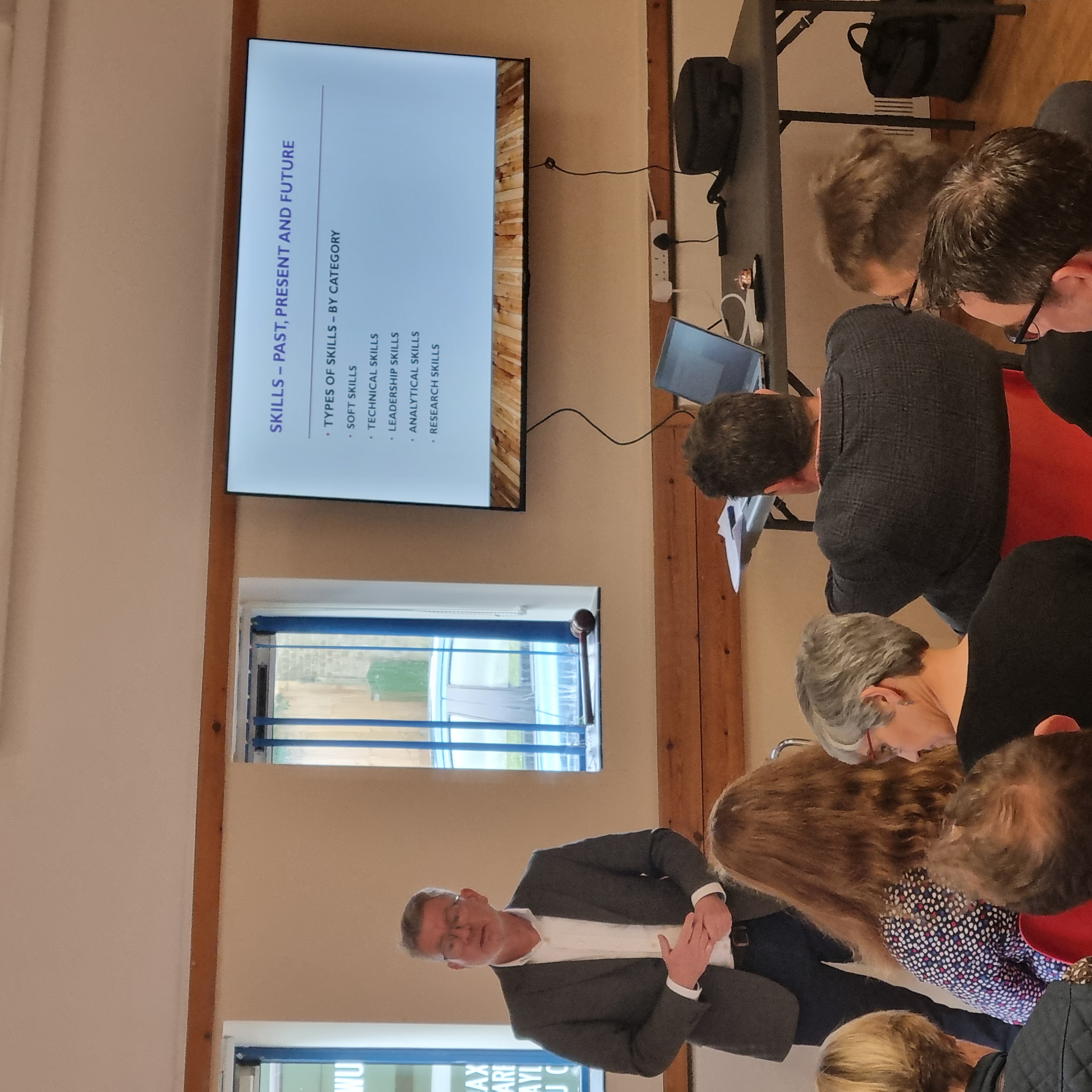
The session by Matthew Sheerin, The Skills Detector, delivered some great takeaways for the supremely skilled, ready-to-work members of M3 Job Club :
1. Adopt a Growth Mindset
Believe in your ability to learn and evolve. Every challenge is a chance to grow stronger, smarter, and more capable.
2. Practice Relentlessly & Self-Coach
Mastery comes from consistent effort. Reflect, refine, and push yourself to improve every day—you're your best coach!
3. Unlock Your Potential with The Skills Detector: CALLS
Explore your Career, Attitude, Likes, Loves, and Self to uncover hidden strengths and passions that fuel your success.
4. Bridge the Gap: Analyse Job Skills vs. Your Skills
Be strategic—compare your current skills with those in your dream roles. Spot the gaps, then go fill them!
5. Know Your Value—and Your Values
Understand what you bring to the table and what truly matters to you. Confidence and clarity are your superpowers.
1. Adopt a Growth Mindset
Believe in your ability to learn and evolve. Every challenge is a chance to grow stronger, smarter, and more capable.
2. Practice Relentlessly & Self-Coach
Mastery comes from consistent effort. Reflect, refine, and push yourself to improve every day—you're your best coach!
3. Unlock Your Potential with The Skills Detector: CALLS
Explore your Career, Attitude, Likes, Loves, and Self to uncover hidden strengths and passions that fuel your success.
4. Bridge the Gap: Analyse Job Skills vs. Your Skills
Be strategic—compare your current skills with those in your dream roles. Spot the gaps, then go fill them!
5. Know Your Value—and Your Values
Understand what you bring to the table and what truly matters to you. Confidence and clarity are your superpowers.